Σελίδες

Εμφάνιση αναρτήσεων με ετικέτα Astrology. Εμφάνιση όλων των αναρτήσεων

Πέμπτη 6 Απριλίου 2017

Erostasia: the Scales of Venus*.

"And when the other is beside him, 
he [the beloved] shares his respite from anguish; 
when he is absent, he likewise shares his longing 
and being longed for, since he possesses
that Anteros, which is the image of love."
~~~Plato, Phaedrus 255d

*The following article was first published in IAM - Infinity Astrological Magazine, March/April 2017, issue 12. Since November 2016, I have the pleasure to be part of the IAM team, writing articles on facets of astrological culture mostly in the ancient world. More information about IAM given at the end of the article.


Planet Venus has been traditionally associated with the need of man to seek out and establish harmonious personal relationships. These Venusian qualities associated with the need to feel close to one another, to feel the comfort and harmony inside and out have been depicted in ancient Greek art through a rare scene known as erostasia or erotostasia literally meaning weighing of the loves (eros). Let’s examine first what the scene of erostasia is all about and then I will discuss the ways we can relate it to the astrological properties of the planet Venus. 


The image on the right[i] shows the Greek goddess Aphrodite (Venus) standing before a young man. In her right hand she holds a pair of scales where in each pan sits a figure of Eros, a winged smaller figure. One of them is identified as Eros, love proffered and the other one as Anteros, love returned or counter love. Even though the meaning of the scene has troubled art historians, we are looking at an erostasia, that is the “weighing of love.” Open to a variety of interpretations it is possibly that erostasia is very close to our own game "he loves me, he loves me not" when one seeks to know whether the object of their affection returns that affection or not. 

According to Greek mythology Anteros was the brother of Eros and the son of the god Mars and goddess Aphrodite; yet the Roman author Claudius Aelianus offers an alternative genealogy saying that Anteros was the outcome of the mutual love between the god Poseidon and Nerites [De Natura Animalium, 14.28]. Anteros in iconography bears many similarities to his brother Eros armed with either a golden club or a set of a bow and arrow, though Anteros is usually depicted with longer hair and two pairs of overlapping wings, like the ones of a butterfly. 
Even though Anteros has been an enigma in art and literature most of the time is set against his brother Eros, where the latter causes people to fall in love and in contrast, the former punishes those who refuse the love of others or fail to reciprocate love. In his book Anteros: a forgotten myth, author Craig E. Stephenson presents all myths about Anteros from ancient to early modern times, summarizing his traits as a god who “appears to represent a dark deity, an avenger of offences against the god of love, but he is also imagined as a counterforce without Eros cannot mature. (p. 12)” Consequently, in most cases Anteros complements, rather opposes Eros. 

Lorenzo Lotto. Detail from Venus and Cupid
This year beginning early March, planet Venus will be retrograde, opening a cycle where we will be given the opportunity to rethink our personal relationships, to re-evaluate what we seek in the companionship of others and whether we feel satisfied and fulfilled by them. It is a period where we may take in our hands our personal scales and like Aphrodite weigh the worth and value of those around us, weigh “our loves.” In this astrological context the scene of Erostasia can be perceived as a constructive image for self-reflection where the scales of Venus are used to remind us the flaws and shortcomings in our need to bond with, to love and be loved by other people. Likewise through this period, retrograde Venus will look in the face of Anteros/others for love and harmony, that is all reciprocal things needed in order for Eros/ love to blossom. 

As in the scene of erostasia where Venus weighs Eros and Anteros, Venus in astrology represents both the unhindered flow of love (Eros) and the influx of love (Anteros). It is a reciprocal action of loving, caring and sensuality for the persons involved. The scene of Erostasia bears one of the basic attributes associated with Venus the harmonious and balanced act of giving and receiving. The need for equilibrium in this Venusian arrangement is also attested in the etymology of the word Anteros: the preposition Anti and the noun Eros, where anti- in ancient Greek signifies something “in return for, in exchange for,” or “as a substitute for.” Therefore one may suggest that the scene of erostasia captures perfectly in an image this dynamic principle related to the astrological Venus as an exchange of energy with others through giving of self and receiving from others. 

The image on the right [ii] is another interesting iconographical example of erostasia where Aphrodite is accompanied this time by the god Hermes. By the same token we can also read in this scene the planetary principles of Venus and Mercury combined. Mercury is associated with the need for communication which is also part of a process involving the flow and influx of information. Looking through the erostasia, if Mercury finds difficulty to communicate his perceptions and ideas to the person which Venus wants to feel close in order to offer her love (Eros/flow), then there’s both an intellectual and emotional difficulty to reciprocate love (Anteros/influx). 

Finally, taking advantage of Venus starting her seemingly retrograde motion let’s weigh our urges and desires when we express and receive affection. Is this about a two-way movement of energy that leads to balanced relationships? In other words where does our scale attunes to, in harmony or discord? There is no better way to express this other than the myth that describes the birth and growth of Eros as recorded by the fourth-century CE philosopher Themistius : “When Aphrodite bore Eros, the lad was fair and like his mother in every way, save that he did not grow to a stature befitting his beauty not did he put on flesh; but he long remained at the size which he had at birth. This matter perplexed his mother and the Muses who nursed him, and presenting themselves before Themis they begged for a cure to this strange and wondrous mischance. So Themis spoke. “Why,” said she, “I will solve your difficulty, for you have not yet learned the nature of the child. Your true Eros, Aphrodite, might indeed be born by himself, but could not possibly grow by himself; if you wish Eros to grow you need Anteros. These two brothers will be the one of the same nature, and each will be the cause of the other’s growth; for as they see each other they will aloike grow, but if either is left alone they will both waste away.” [Themistius, Orations 24]. 

As a final thought, while the outcome of picking one petal off a flower to determine whether “he/she loves me … loves me not” may lie outside our control, we can always borrow the Venusian scales and hold the balance in our hands. If the outcome is not to your satisfaction you can alternatively start picking the feathers of Eros and Anteros wings. Have a wonderfully balanced Venus retrograde time!

 Bibliography:
  • Stephen Arroyo, Astrology, Psychology and the Four Elements (CRCS Publications, 1978)
  • Craig E. Stephenson, Anteros: A Forgotten Myth (Routledge, 2011)
IAM - Infinity Astrological Magazine
IAM-Infinity Astrological Magazine is a bimonthly online magazine, founded in 2015 by Serbian astrologer Smiljana Gavrančić. IAM is for professionals astrologers, students of astrology and for all astrology lovers.
Serbian astrologer Smiljana Gavrančić is the founding editor and owner of IAM. She specializes in exploring significant degrees in Mundane Astrology and her writings have appeared in the Astrological Journal and in The Mountain Astrologer blog and in ISAR’s International Astrologer.
As of November 2016, all issues of IAM have become part of AlexandriaiBase Project (www.alexandriaibase.org), a digital astrological database.
From March 2017, IAM is on featured in the Astrodienst (www.astro.com) section ''Understanding Astrology'' along with the Astrological Journal and the Mountain Astrologer.
IAM is associated with most relevant schools, journals and people in the astrological field.
You can download all IAM issues for free at the following link:  infinityastrologicalmagazine.com


[i] Apulian Red Figure amphora, British Museum, London (ca. 350 BCE)
[ii] Attic Red Figure Krater,   National Archaeological Museum, Athens (ca.  400 - 300 BCE)

Τρίτη 27 Δεκεμβρίου 2016

Mars in Pisces conjuncts Neptune: Zen in Action.

Take me on a trip upon your magic swirling ship
My senses have been stripped, 
My hands can't feel to grip
My toes too numb to step.
~Bob Dylan, Mr. Tambourine Man [1965]

Photo by Vasilis Linidis
This year is just about to end and one of the important planetary aspects happens in "zen waters." Mars, the planet of desire and will towards action, sets up his camp in the sign of Pisces, where Neptune the planet of transcendent freedom has been reigning strong in his kingdom for the last five years. This may sound as a challenging conjunction considering that Mars already in Pisces seems to be like "a fish out of water." On the other hand, Neptune is in the sign he rules where he attunes perfectly with the urges and needs that the planet has been traditionally associated with: merging with whole and escaping limitations of self-boundaries. 
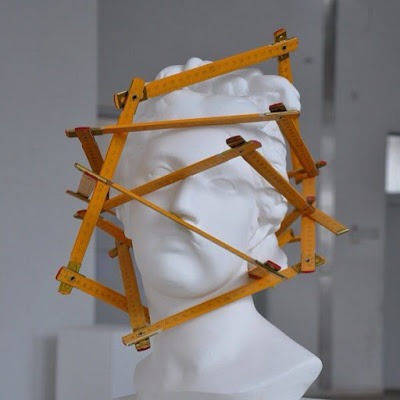
This seemingly odd union between Mars and Neptune in Pisces is symbolically described in one comic dialogue written by the first-century CE Greek writer and satirist Lucian of Samosata. In this dialogue the god of seas and rivers, Poseidon (the Greek name for Neptune) is talking to his legendary son Polyphemus the Cyclops who has just been blinded by Odysseus. The words of the Cyclops fit very nicely to the key concepts related to Mars in the sign of Pisces. As I will discuss below Mars in this sign is like the blinded Cyclops where his physical energy and drive seem to lack direction upon touching water. However, the dialogue/conjunction between Mars/Cyclops and Poseidon/Neptune in this Piscean campaign, provides many insights about this planetary transit. So, let's see in some detail how these energies debated the journey of the fiery Martian essence through Neptune's kingdom.

"Oh help me, Father!"
The dialogue starts with Cyclops complaining to his father: "Only look, father, what that cursed stranger has been doing to me! He made me drunk, and set upon me whilst I was asleep, and blinded me.[...] He called himself 'Noman' at first: but when he had got safely out of range, he said his name was Odysseus. [...] The villain! that name of his was just a trick! And what I minded most was the way in which he made game of my misfortune: `Not even Papa can put this right,' he said."
Cyclops' words describe some of the attributes related to Mars in the sign of Pisces. Even though restless, Mars here is also passive and withdrawn as the Cyclops who has lost his sight yet he wants to take action for what has happened to him. He is outside of his cave seeking the one who deceived him with alcohol and then blinded him, seeking the one who is no one with no name. He is trying to be assertive taking control over his life, but is confused as if he has been literally blinded. Mars in Pisces as Cyclops in Lucian's dialogue feels short in directing his aggression: he sits outside his cave letting his pasture out, while the one who blinded him is slipping away (Odysseus) under a ram's belly. We can also see here the subtle difference of Mars in Pisces/Cyclops and Mars in Aries/Odysseus who is all about outward action and always one step ahead. 

"Go with the Flow, Son!"

So what piece of advice does Poseidon offer to his son? In few words he advises to take a short break from action or follow zen in taking action: "Never mind, my boy; I will be even with him. I may not be able to cure blindness, but he shall know that I have something to say to mariners. He is not home yet." Poseidon's words is another way to make sense of this unusual union of Mars and Neptune in Pisces. To harmonize these energies (fire and water) Neptune directs Mars to slow his pace and surrender his tempo to a tranquil flow. This is not a time of pioneering action, rather it is a period for one to reflect upon a personal Martian quest but in spiritual colors. Impatience needs to be tamed to sustain the fiery Martian energies, otherwise water will eventually evaporate. 

Poseidon/Neptune admits to Cyclops/Mars that he cannot give him back his sight. Swimming in Neptunian waters is all about surrender and experience a oneness with life itself; that is water where life emerged in the first place. Poseidon tells his son, that it is not yet the time to find and punish who did this to him. Therefore, during this irregular planetary conjunction of Mars and Neptune in the sign of Pisces, the words of Poseidon to the Cyclops provide the best of advice: be patient and go with the flow. Poseidon will take care of business punishing the one with no name who did this to his son. But, only when Mars enters his Arian home. Now is not the time. Besides, in Neptune's words ... Mars "is not home yet!".


Sources:
  • Lucian's Dialogue: "Cyclops and Poseidon" in http://www.theoi.com/Text/LucianDialoguesGods2.html#2
  • Arroyo S., Astrology, Psychology, and the Four Elements. An Energy approach to Astrology and Its Use in the Counseling Arts. [1975]


Πέμπτη 10 Νοεμβρίου 2016

Dance Me to the Scorpio Ball: "Princess Grace’s 40th birthday party"

"Fairy tales tell imaginary stories.
Me, I am a living person. I exist."
                                                                                                ~Grace Kelly.

Scorpios are known to leave their everlasting sting, mostly because they timely and wisely calculate their move, which undoubtedly is quite often aesthetically perfect. This was the case of the real-life princess Grace Kelly of Monaco, a Scorpio who for her 40th birthday threw a Scorpio-themed party. According to the newspapers of the time "guests ranging from European royalty to a Spanish bullfighter were among the 60 Scorpios Princess Grace invited to her 40th birthday ball" [1]. It is known that Kelly was into astrology and she regularly requested predictions sent to her from the renowned American astrologer Carroll Richter. If we look at her chart, first house looks like a Scorpio ballroom where along with her Sun and Ascendant, Mercury and Mars dance along with Pluto following his “trine-steps.” [Pluto trines both her Sun and Mars] [2].

Only Scorpios Invited!
In 12th November 1969, Grace turned forty. According to her biographer, shortly before her birthday she decided to celebrate it as she has never done before. She contacted Carroll Richter, the American astrologer in California who used to organize monthly Zodiac parties for the pertinent signs and exclusively invited only those who fell under a particular sign [3]. Taking a nod from him, Grace invited on Saturday, November 15th, 1969 to a dinner party and dancing only Scorpios and friends who were married to Scorpios. The grand Belle Époque hall of the Hotel Hermitage in Monte Carlo opened its doors to accept the sixty guests. Following the scorpio theme, the palatial ball and dining room were decorated with portraits of famous Scorpio individuals hung on the walls, such as Edgar Allan Poe, Queen Marie Antoinette and the sculptor Auguste Rodin.

Show me your Scorpio Colors! 
The invitations sent out to the guests asked from the ladies to dress in the colors of Scorpio, predominately red but also black and white. Though the invitations bore the inscription High Scorpia, other associated Zodiac signs would be tolerated.  In Grace’s opinion Scorpios and Geminis were two signs could never be in harmony [3]. Ironically, the man she married, Rainier III, the Prince of Monaco was a Gemini who wore a red shirt and handkerchief, predominantly a Scorpio color, with a black evening suit [3].
Princess Kelly accompanied Rainier in a black velvet Balenciaga gown. The ruby cabochon and diamond brooches she used to adorn the dress were detachable pieces from the Monégasque Bains de Mer tiara, designed by Cartier. Grace also wore a matching ruby ring [4]. In this Scorpio context, Grace called herself “Her Scorpio Majesty”, a title that according to her biographer she used again and again at other occasions, when she invited her old friends from Hollywood to gather together [3]. Let's see some more pictures of her Scorpio Majesty and those invited. (most of them through TheGettyImages website)
Veteran Singer Josephine Baker arrives with an unidentified escort 
at Princess Grace's Scorpio birthday party.
Italian actress Virna Lisi and her husband.

Actor David Niven and his wife.

A Pisces in Scorpio Robe! 
Even though Grace’s birthday party was dominated by Scorpios, a famous Pisces actress managed her way to the Scorpio ball and became the center of attraction. Accompanied by her fellow actor and husband Richard Burton who was Scorpio, Elizabeth Taylor appeared at the party dressed in a black velvet robe decorated with the Princess’s astrological sign. Taylor displayed for the first time in public the legendary 69.4-karat, $1 million Taylor-Burton Diamond, which Burton had bought for her recently—on a double-strand necklace of smaller diamonds. According to Taylor, “first the diamond was flown from New York to Nice in the company of two security guards, who delivered it to her and her husband aboard their yacht, the Kalizma. The Burtons were then escorted to the party with their security guards, who were armed with machine guns as added protection.” [5].


The “Bite and Sting” Birthday Cake!
The centerpiece of any birthday party is of course the cake. Grace chose to treat her guests with a scorpio-themed 166lb (approx. 75kg) birthday cake. The giant birthday cake had golden scorpion decoration and it was too big to go through the hotel door. It had to be cut in half by the chefs before it reached the party [1]. On the following day of the party, the guests were invited to have breakfast at the swimming pool of the neighboring Hôtel de Paris, where they had also been lodged.

Sources:
~ [1]. The Australian Women's Weekly, Wed 17 December 1969.
~ [2]. Grace Kelly – Princess of Monaco Published: September 22, 2016 I. Author: Smiljana Gavrančić in http://astrologsmiljanagavrancic.blogspot.gr/2016/09/grace-kelly-princess-of-monaco.html
~ [3]. Grace: A Biography by Thilo Wydra [Skyhorse Publishing; 2014]
~ [5]. Bling-Bling! Bang-Bang! Liz Taylor Attends Grace Kelly’s Scorpio Ball in  https://lisawallerrogers.com/tag/princess-graces-scorpio-party/

Δευτέρα 17 Οκτωβρίου 2016

Mars conjuncts Pluto: a Sisyphean labor?

“The struggle itself toward the heights 
is enough to fill a man's heart.
One must imagine Sisyphus happy.”
~A. Camus, The Myth of Sisyphus.

Artwork by The Chewu
The myth of Sisyphus is one of the most poignant insights into the archetypal process of becoming , which idealizes process over achievement. According to the myth as a punishment for revealing the secrets of the gods, Sisyphus is condemned for eternity to roll the rock up a hill, only to watch it roll back down, and then to begin the process once again. Sisyphus’ story represents the willingness of man toward acts that even though they may seem futile, speak to the urge toward total rebirth, celebrating the frustrations of human existence. Sisyphus’ story is a story of aspirations and actual limitations which can transform the human condition. In the language of Astrology Sisyphus’ story echoes the upcoming conjunction between the planets Mars and Pluto in the sign of Capricorn.
Image: medi
Before rolling out the myth of Sisyphus on the Plutonian terrain, let’s talk about how these two planets can be said to represent a particular dimension of experience which is coloured by the cardinal and earthly qualities of Capricorn. Mars symbolically manifests principles associated with drive, physical energy, initiative and desire. It is the aggressive and self-assertive urge of man to act decisively in order to fulfil his need to accomplish his goals and meet his physical and sexual excitement. Concepts of transformation, transmutation and elimination have been traditionally associated with Pluto. Despite the so-called “icy-heart” formed on his surface, as NASA's New Horizons images revealed last year, Pluto represents the urge to penetrate to the core of experience, which entails total rebirth and symbolizes man’s need to let go through pain and explore new paths of personal existence.


Martian qualities filtered through the sign of Capricorn describe the kind of will-power that is methodically, consciously directed and determined to get things done.  In spite of its presence in the outskirts of the solar system, Pluto in Capricorn  speaks of  the physical realm as the key transformative energy of the transpersonal.  Here, the subconscious energies to refine oneself  are attuned to the forces of perseverance and ambition,  calculated effort and exceptional determination of one’s mind and will power to transform. Hence, Pluto in Capricorn  demonstrates that even transpersonal or transcendental realms do have immense and tangible power.  Combining the expressions of the two planetary principles, Mars in Capricorn steps into the Plutonian mountain goat fields with an agenda in his mind: to pursue personal achievement and transformation driven by his willingness, physical potentiality and perfectibility, yet facing his deepest desires and urges.  

It is wonderful how Sisyphus’ myth expresses both the planetary-sign principles of Mars and Pluto in Capricorn, and integrates their angular relationship—in this example the conjunction—not only self-destructively, but also positively as I will explain. In Greek mythology Sisyphus was believed to be the founder of Corinth and like Odysseus was both glorified and stigmatized as “the most cunning of men”. His name has been synonymous with deception, when he decided to rebel against the gods and share their powers by breaking down the boundaries between the divine and the human. The story of Sisyphus’ descent to the underworld as punishment for this defiance against the gods appears in a few versions, but the central theme is the same: Sisyphus betrays Zeus’ secrets and he is condemned to push a rock up a hill in Hades, only to have it roll down again once he reached the top. 

Although the myth here denotes that death is part of the natural process of life, and a form of punishment, especially for those who are trespassers of the divine mysteries, Sisyphus steps in the underworld with his own agenda. Ambition, selfishness and lust for power drives Sisyphus to outwit Pluto, the god of the Underworld by persuading him to demonstrate the use of his chains, and then he tied up the god in his own capturing device. Pluto became a prisoner in his own home, while Sisyphus’ improper use of force and will delivered humans from death, at least temporarily. If we extend the threads of this story and tie them to the expressions of the planetary principles as described earlier, we can easily recognize how Sisyphus’ myth is attuned to astrological language.

Artwork by Paulo Vinlua.
Sisyphus’ meeting with Death resonates with the disharmonious expression of the Capricorn energies and qualities of Mars and Pluto when conjunct. In a state of disharmony and discord, Mars/Sisyphus to avoid death upon his meeting with Pluto decides to pursue his selfish aspirations. Merging with the Plutonian transformative energies, Mars willfully manipulates others to serve his own agenda. To avoid the pain of facing his own death—symbolically and literally—Mars/Sisyphus ruthlessly uses any means to meet his aspirations, deepest desires and compulsions, rather than his limitations. Infatuated with the Plutonian power of rebirth and regeneration Mars/Sisyphus fails to achieve his personal transformation and positively transmute pain through effort and experience. Mars’/Sisyphus’ hard work to trick Pluto does pay off, but fails to experience his ideal self, where the triumph of his will-power will not overthrow the counter-will of the gods.

Artwork by Vladimir Kush
The fact that Pluto was chained and nobody could die did not alleviate the fear of death. The upcoming conjunction of Mars and Pluto can be experienced in harmony with the higher universal law, which dictates that the principles regarding rebirth and transformation could help man to ameliorate the anxiety of dying. Mars’ self-determination and urge can be used not to defend oneself against “death”, but to accept the urge towards total rebirth. Using his calculated vision and raw primal energy, Mars in Capricorn or Sisyphus can redefine the seemingly burden of the infinite rock-rolling cycles. In order to experience harmoniously the planetary principles of this aspect, Mars needs to internalize the transformative cyclical process of Pluto applying both human perfectibility and transcendent excellence. Each one of us must train his/her inner Sisyphus to discipline his will and accept his limitations, yet to transmute them through effort and intensity of experience. A positive expression of the Mars Pluto conjunction does not paint a futile and hopeless Sisyphean labor. On the contrary it may inspire man to reengage in this cyclical process without the consolation of achievement.

Ganu Gancheff
Sisyphus’ myth exemplifies the effort of man to assert the powers of his own free will and aspirations to achieve a transparent excellence; this is one of the main themes that the conjunction of Martian and Plutonian energies represent. So, is this Mars-Pluto conjunction nothing more than a Sisyphean labor? Focusing on Sisyphus’ ascent over the hill rolling the rock, we see an aspiring man. Focusing on Sisyphus’ descent we see the suffering defeat of man’s aspirations. What may seem as a cyclical rock-rolling punishment, which is symbolically related to the elemental earthly qualities of the physical senses and the here-and-now reality of the material world—attuned to the Capricorn qualities too—is only a reminder that all human endeavors involve both aspiration and frustration. But if we focus on both aspects of this cyclical labor, or on both aspects of the Mars-Pluto conjunction then Sisyphus and ourselves are capable of experiencing the wholeness of human existence, not as a finished form but as a process.

On a last note, we know today of two lost plays about Sisyphus written by the ancient Greek tragedian, Aeschylus: Sisyphus the Runaway [Δραπέτης] and Sisyphus the Stone-Roller [Πετροκυλιστής]. The existence of these two clearly distinct epithets attributed to Sisyphus seem to allude nicely to the major themes that the conjunction of Mars and Pluto represent. The Sisyphean archetype synthesizes both aspects of the Sisyphean cyclical labor, where free will meets the aspirant man, but it does not reduces his experience and effort to futility. The Mars-Pluto conjunction is an opportunity to “roll in the deep” both as a Sisyphus the Runaway and as Sisyphus the Stone-Roller.

Bibliography:
~S. Arroyo, Astrology, Psychology, and the Four Elements (1975)
~D. Cunningham,  Healing Pluto Problems (1986)
~E.M. Simon, The Myth of Sisyphus: Renaissance Theories of Human Perfectibility (2007)
~K. Pietruczuk, “The Sisyphus Plays of Aeschylus,” Museum Helveticum 68 (2011) 129-140.

Σάββατο 8 Οκτωβρίου 2016

Jupiter in Libra and the Scales of Fate.

"Big iron kitchen scales 
and a full set of weights
aren't carried lightly."
~Terry Pratchett, The Truth


Zeus has been traditionally associated with a series of symbols, such as the thunder bold and the eagle. However, “loudly thundered from mountain Ida” Zeus is portrayed two times in the Iliad holding and consulting his famous golden scales. In a few days beyond and higher than mountain Ida, “Zeus of the Skies”, planet Jupiter is going to hold up for almost a year another pair of scales, transiting through the sign of Libra. 
In the Iliad at the beginning of Book 8, Zeus lifts up his scales and he weights the fates of the Greeks and Trojans; later in the poem he consults once more his scales to weight the fates of Achilles and Hector. Scales should be of course impartial and objective, but we usually forget that Zeus has already made his decision who will be victorious in the end. He already knows what the future holds. The fact that Zeus consults the scales doesn’t indicate a submission to fate, rather points out the equilibrium before one the contestants proves superior in the battlefield. Zeus is just the beam of the balance. 
Issues of balance, fairness and equality in relationships and partnerships are among the many things that Jupiter in Libra places in his scales during this transit. Jupiter in Libra embodies the above qualities, but he doesn’t control the scales. Like any other planetary transit, this depends a lot on the way us as individuals approach our lives and assess this transit, when our endeavors fall out of balance. Jupiter in Libra may determine the weight of things, but he’s not the one weighting the fate. 
Scales can be a devious object, leading to anxiety over their accuracy. Every time we hop on a scale the possibility of perfect justice and equity is dubious, which makes the question of “how much we weight” a very provocative subject. So, what makes Jupiter in Libra a perfect motif for equality of balance between two contending parties, is that the scales both stand as a metaphor for ideal and impartial justice and leave room for the possibility of doubt and anxiety about the outcome. 
In the ancient world, there was a special class of administrators, the metronomoi, who were responsible for inspecting and testing the commercial scales, weights and measures. In the case of suspected tampering, the metronomoi could file for complaint or appeal. That said the transit of Jupiter in Libra calls us to become the metronomoi of our relationship-related issues, even the ones we literally have with our bathroom scale. Just as Zeus did not interfere with the verdict of the scales in the Iliad, we cannot expect the transit of Jupiter in Libra to lift one’s bad deeds out of the scale-pans, or to expect impartial scales to begin with. To be sure we may experience the “anxiety and fear of the scales” during this transit. But by including them in this transit, Jupiter in Libra offers us a chance to be more able to fully appreciate the strong fairness and justice resonance that the image of the scales provoke. 


Τρίτη 6 Σεπτεμβρίου 2016

Tie Your Sandals, Mercury Retrograde!

"So spake he [Zeus], and the messenger, Argeiphontes, 
failed not to hearken. Straightway he bound beneath 
his feet his beautiful sandals, immortal, golden, 
which were wont to bear him over 
the waters of the sea and over the boundless land 
swift as the blasts of the wind."
~Homer, The Iliad Book 24, 339-342


In Greek mythology, sandals with or without wings have been related to Hermes (Mercury), the only god in the Greek pantheon who freely crosses boundaries. In the astrological language, Hermes’ crossing of thresholds reminds a lot the customary turn of the planet Mercury from direct to retrograde and the opposite.

In the last book of the Iliad, we read that Achilles had been abusing Hector’s body to revenge the death of his best friend Patroclus. After twelve days, Zeus decided that this must come to an end and he sends Hermes, disguised as a soldier to guide the father of Hektor, king Priam through the Greek camp to receive Hektor’s body. It’s really interesting that this crossing takes place at night—which symbolically reminds the time when Mercury enters the shadow face, before turning retrograde. As soon as Hermes hears Zeus’ orders, he ties his “immortal sandals” to slip through the enemy’s camp, because he wants to offer consolation and closure to half-finished issues; it’s the sandals that they are going to secure his safe, soundless and hidden passage, alternating his role from the Messenger to the Conductor of souls…alternating from direct to retrograde movement. 

From this point, Hermes-Mercury takes upon an inward looking which is going to lead the mind to its own personal descent to the depths of the unconscious, so that to succeed in bringing to light what had remained hidden. Hermes in the story is dressing himself up the role that enables him to cross the boundaries between the Greek and the Trojan camps, the boundaries between the winners and the losers, the boundaries between the living king of Troy and his dead son. Complementary, planet Mercury ties his own sandals to carry our thoughts beyond our personal boundaries, during the retrograde time when by all appearances every action and communication has seized. Likewise, Hermes leads Priam through a river-boundary that separated the two camps, while the Greeks and the Trojans had agreed to an armistice. As we are called to cross our personal boundaries during the retrograde period and contemplate our past, Achilles is required to overcome his anger and grudge for his friend’s death, and let the dead body of Hektor to receive the customary rites. King Priam is also crossing his boundaries for, even a king he needs to find the courage and strength to meet the killer of his son and kiss his hand.
Hermes' sandals in this story and in general bear a special meaning which is related to the passage from one point/state to another. It was customary for the ancient Greeks to put in the graves of their beloved ones small clay boots, especially found in children’s tombs. It is not a coincidence that today in happy events we usually buy new shoes. In the ceremony of baptism, new shoes and clothes are presented to the one baptized to celebrate his/her admission to the Church. Even, when someone dies, he/she always has a pair of shoes on—maybe even a new one. So, probably there is a connection here with Hermes’ sandals and his crossing through boundaries. It is evident that shoes compliment symbolically a ceremonial act, but they also enable and provide crossing thresholds safely. Hey, even Hermes needed them!
So during this Mercury retrograde season, let’s tie our “mercurial sandals”, make our amendments and redefine our choices. This way, we can freely cross “over the waters of the sea and over the boundless land swift as the blasts of the wind”, just like Hermes did every time he put on his feet his beautiful immortal golden sandals.

Bibliography:
~Cursaru, G., "Les sandales d'Hermès, I. Les καλὰ πέδιλα homériques d'Hermès," Rivista di Filologia e di Istruzione Classica 140. 1 (2012) 20-61
~Greene L. and Sasportas H., The Inner Planets: Building Blocks of Personal Reality (Seminars in Psychological Astrology) [Samual Weiser (1993)]
~Yalouris, Ν., "Πτερόεντα Πέδιλα," BCH 77 (1953) 293-321.

Πέμπτη 24 Μαρτίου 2016

"Worship of the Stars"- Sophia Centre Conference 2016 [English]

Cassius: "The fault, dear Brutus, 
is not in our stars, but in ourselves."
Shakespeare, "Julius Caesar" I, ii 140-1

In some cultures the sun, moon, stars and planets are worshipped. In others they may be revered as representatives or symbols of divinity. Sometimes the sky itself is divine. In sacred texts celestial bodies are often metaphors for, or symbols of, gods or goddesses. Often sacred spaces and buildings are designed with a specific relationship to the celestial bodies. This is the theme of this year's conference of the "Sophia Project for the Study of Cosmology in Culture", which is going to take place in Bath on 25-26 June 2016. The title of the Conference is "Worship of the Stars: Celestial Themes in Observance and Practice of the Sacred". The talks presented examine the relationship between the sky, the celestial bodies and notions of divinity, religious practice and observance, and explore a variety of perspectives, through imagery, myth, anthropology, architecture, performance, literary studies and the history of art and the study of religions. More information about the speakers and abstracts of their talks: http://www.sophia-project.net/conferences/WorshipOfStars/speakers.php


"Hubris in the Skies"
In this year's Sophia Center Conference, I have the honor and pleasure to participate as on of the speakers. The title of my talk is: "Hubris in the Skies: expelling the sacred in Aristophanes' 'Birds' and 'Clouds'."
Abstract: To ancient Greeks the sun, the moon and other celestial bodies were thought to be personified divinities. Nonetheless, voices seeking non-supernatural explanations for celestial phenomena were already present in the writings of pre-Socratic philosophers. Even so, to re-imagine cosmic order governed predominately by the laws of nature and not the divine was to invite trouble, since it was perceived in one way or the other as sacrilege. In Clouds, the comic playwright Aristophanes makes implicit references to this tension, when he criticizes the corrections on the Athenian civic calendar made by the famous astronomer and mathematician of his time, Meton. On the same grounds, in Birds Meton is introduced as an air-geometer of a "star-city" located on the heavens. Beyond the comic element of the scene, the use of geometrical language to define and consecrate the city may have a further motive. I would therefore purpose that we may see Meton's role in both plays as an expression to target those social elites and intellectual thinkers, such as Socrates who were held responsible for stripping away the sacred related to the observation of celestial bodies and phenomena.

A few words about the "Sophia Project for the Study of Cosmology in Culture"


The Sophia Centre for the Study of Cosmology in Culture, a research and teaching centre within the School of Archaeology, History and Anthropology at the University of Wales Trinity Saint David. The Centre's remit is the consideration of how we live on planet Earth, with particular reference to the sky and cosmos as part of the wider environment. Its work is partly historical, partly anthropological and partly philosophical. It has a wide-ranging remit to investigate the role of cosmological, astronomical and astrological beliefs, models and ideas in human culture, including the theory and practice of myth, magic, divination, religion, spirituality, architecture, politics and the arts. It deals with the modern world as much as indigenous or ancient practices. Its current projects include the Harmony Initiative which explores how people can or do live in harmony with the planet and connects to wider environmental concerns. The Centre supervises PhD students, holds conferences, publishes, sponsors events and teaches the University's MA in Cultural Astronomy and Astrology.